

The original JILI Charge Buffalo has six reels and four rows in its provider artwork, free-spin features and four published RTP settings. Confirm the edition, read the full stake and check the current game listing before choosing where to play.
Which Charge Buffalo are you opening?
When a Philippine casino lobby lists Charge Buffalo, the name may refer to the original JILI release, the separate Charge Buffalo Ascent game, or 3 Charge Buffalo. The official listing and PAGCOR records identify the original by its own title, and its provider description states four rows, six reels and 4096 arrangements, although separate metadata mentions 40 paylines. That conflict is unresolved in the source material, so do not assume either figure describes the exact build in front of you. The promotional artwork we inspected clearly shows six columns and four rows on screen.
The original is rated medium volatility with a maximum win of 4000 times your stake. Its published technical sheet lists four RTP configurations: 96.08, 96.53, 97.03 and 97.51 percent. Which setting an operator actually runs is not something we could verify, and RTP is a theoretical long-run average, not a forecast of your session. A quoted hit frequency of 25.60 percent appears on the sheet, but the provider does not define it, so it cannot be read as the rate of profit or the rate of triggering free spins.
For a novice, the practical check is simple. Open the information panel inside the game itself and confirm the title, the reel layout, and the help pages before wagering anything. If the screen shows five reels and 40 lines, you are likely looking at Ascent; if it shows four rows across five reels with 1024 ways, that is 3 Charge Buffalo. Matching what you see on screen against the original's stated six-reel layout takes seconds and prevents you from budgeting for the wrong game.
Finally, a game appearing in a regulatory listing does not prove that any particular operator is licensed, that the game is currently stocked, or that GCash or Maya deposits and withdrawals will work there. Treat the provider's pages as the description of the game itself, and judge the venue separately on its own terms before you create an account or deposit pesos.
Follow one complete paid round
A paid round in Charge Buffalo follows the same loop as most video slots: you set a total stake, press spin, the six reels stop, any winning arrangements are counted, and the win is added back to your balance. Official promotional screenshots show the standard layout: balance on one side, bet in the middle, win on the other, plus a settings gear, a lightning icon and repeat/spin controls. One example screen shows Bet 10 and WIN 120; that is provider artwork, not a settled result we observed ourselves.
Here is a fully hypothetical illustration in pesos, with no claim that any specific stake level exists in Philippine pesos. Imagine you set a stake of 10 pesos per spin and play twenty spins, spending 200 pesos in total. Suppose eighteen spins return nothing, one spin returns 15 pesos, and one returns 60 pesos, for 75 pesos back. Your net result is a loss of 125 pesos, which shows why individual sessions routinely differ from any published RTP figure.
Now imagine the same twenty paid spins but one triggers the free spins feature. The original's description confirms that scatters award free spins, that more scatters can award more spins, and that wild multipliers appear during free games. What the sources do not confirm are the exact scatter counts needed, whether retriggers are possible, or how multipliers combine, so do not rely on numbers you see quoted informally elsewhere.
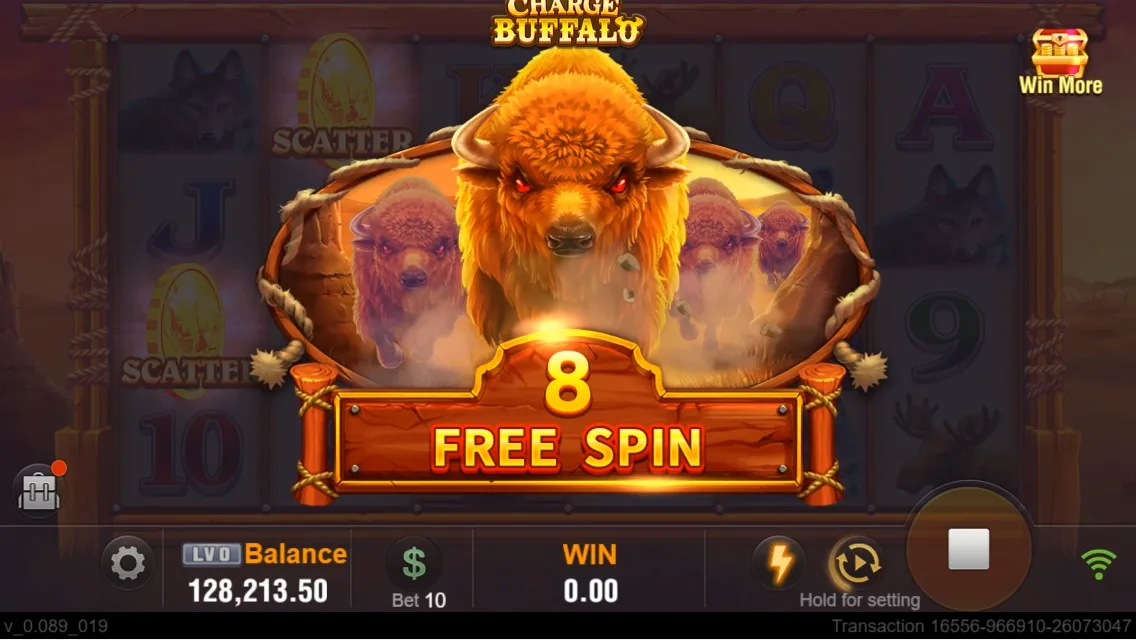
The discipline that matters is at the end of the round: read the final win line and your updated balance rather than relying on feel. The promotional art shows an 8 Free Spin screen and a single win of 51 during free games alongside a 2x wild; this is one provider example and does not show what typical feature results look like. Decide your session budget in pesos beforehand, and count the whole batch of rounds as one cost, not spin by spin in isolation.
Six reels, four rows and ways to win
The original Charge Buffalo uses a ways-to-win style layout rather than fixed paylines: four rows across six reels gives 4 multiplied by itself six times, which equals 4096 possible symbol arrangements. That number describes how many paths exist for matching symbols to land across adjacent reels. It does not mean 4096 chances of profit per spin, and it says nothing about probability, because most arrangements will not line up the symbols the paytable requires.
To make this concrete, consider a simplified hypothetical. Suppose a buffalo symbol appears in 2 of the 4 positions on reel one, 1 of 4 on reel two, and 3 of 4 on reel three. The matching paths run 2 times 1 times 3, which is 6 distinct ways through those three reels. Whether that combination pays anything, and how much, depends entirely on the official paytable, which is not fully published in the source material we inspected. Never assume all six reels must match, and never treat a ways count as a promised return.
The source metadata does contain an unresolved conflict: the game description says 4096 arrangements while a metadata field separately says 40 paylines. Because we cannot reconcile these, the honest guidance is to open the in-game help screen and read how wins are evaluated in the exact version you are playing. A ways game typically pays left to right from the first reel across adjacent reels, but the in-game rules page is the authority.
For budgeting, the sheet's example stake range runs from 0.10 to 100 in euros with 0.30 as default, but peso limits for Philippines players were not verified. Hypothetically, if a build offered 1, 5 and 20 peso stake steps, then moving from 5 to 20 quadruples both your cost per spin and, in linear proportion, every prize. Path counts explain how a combination is counted. They do not tell you how frequently symbols appear or how variable the returns will be.
Buffalo, Wild and Scatter do different jobs
The original Charge Buffalo from JILI uses a six-reel, four-row board, and the symbols on it fall into three functional groups: regular paying symbols such as the buffalo, the Wild, and the Scatter. Paying symbols form combinations across the board's arrangements; the source art we inspected shows six columns and four rows, consistent with the provider's description of 4096 arrangements. In slot terminology a Wild normally substitutes in ordinary combinations; the exact eligible symbols and exclusions must be read in this game's help. In this game wilds also matter beyond the base game, because wild multipliers feature during free games, a point confirmed in the game's official description.
The Scatter is associated with the free-spin feature: scatter symbols award free games, and more scatters can award more spins. What we cannot confirm from the evidence is the exact trigger count, the mapping of scatter numbers to spin totals, or any retrigger schedule, so do not assume three scatters means a fixed number of spins. Promotional art shows an 8 Free Spin screen, but that is a provider example, not a guaranteed outcome.
A practical way to think about the split: buffalo and other regular symbols drive the ordinary base-game returns, the Wild patches near-misses into wins, and the Scatter controls access to the free-spin feature, where the provider says wild multipliers appear. Official sheets show the base game contributing roughly 59.92 of the theoretical 96.07 RTP in one configuration, with the bonus contributing 36.15, which tells you a large share of long-run value sits in the free-spin feature.
Because the paytable itself is unverified, do not quote exact symbol values as fact. When you load the game, open its built-in information screen first and check what each symbol pays and what triggers free spins before placing any stake.
What changes during free spins
Free spins in Charge Buffalo are awarded by scatter symbols, and landing more scatters can award more spins. Once the feature starts, two things change compared with the base game. First, you are no longer paying per spin: the same stake that bought the triggering round now covers a sequence of spins at no extra cost. Second, wild multipliers come into play. Where a wild helps complete a combination during free games, it can multiply that win, which is why the feature carries a disproportionate share of the game's theoretical return.
Provider promotional art illustrates this with a free game screen showing a win alongside a wild marked 2x, showing a multiplier label without establishing which part of the displayed return it affected. Another promotional image advertises a 5x wild and a 99 Free Game figure. Treat these as artwork showing what the feature can display, not as verified paytable values or promises of what your session will produce. We did not find evidence confirming the multiplier ladder, the number of spins per trigger, or whether retriggers follow a published schedule.
Marketing language mentions unlimited free games. Read that carefully: it is marketing language, and the sources do not confirm the retrigger mechanics behind it; in any case it cannot mean unlimited cash. Every spin still resolves against the paytable and random outcomes, and the sources do not confirm the exact conditions under which the free-spin sequence ends.
Worked hypothetical, labelled as such and not a real result: imagine you staked 10 pesos, triggered 8 free spins, and across them the wins totalled 120 pesos. Your net for that entire sequence is 110 pesos of profit on the original 10 pesos, because the free spins themselves cost nothing extra. If the same feature returned only 6 pesos total, your net would be minus 4 pesos. Free spins change the cost per spin, not the arithmetic of risk.
If free-spin rules differ between operators, the in-game help screen is the authoritative source for that session.
Read the stake and the final return
Every settled round in Charge Buffalo resolves to two numbers you must read together: the stake you committed and the amount the Win field credits back. Nothing else, animations, near-misses, or multiplier flashes, changes that ledger. The official sheet lists EUR bets from 0.10 minimum through a 0.30 default to 100 maximum, but Philippine peso limits on any given operator are unverified, so always read the live bet field rather than assuming a range.
Worked hypothetical in pesos, not an actual stake or result: suppose your stake shows 10 pesos. The spin settles and the Win field shows 12 pesos. Your return is 12 pesos and your net is plus 2 pesos. If the Win field shows 4 pesos, you received 4 pesos back and your net is minus 6 pesos, even though the game labelled it a win. If it shows 0, you lost the full 10 pesos. This cost-versus-return-versus-net framing is the only honest way to read a spin.
The game's theoretical RTP sits between 96.08 and 97.51 percent depending on configuration, with hit frequency listed at 25.60 percent in the sheet. Neither figure forecasts your session. RTP is a long-run average over enormous numbers of rounds, and the hit frequency's exact definition is not supplied, so you cannot treat 25.60 percent as a profit rate or a bonus rate.
Maximum payout is stated as 4000x the stake. Purely as arithmetic, 4000 times a hypothetical 10 peso stake would be 40000 pesos, but this is a ceiling, not an expectation, and the vast majority of rounds return far less or nothing.
Before each spin, confirm the stake displays the amount you intend and the balance reflects your last result. If either number surprises you, stop and check the bet controls rather than spinning again.
Read the controls before using shortcuts
The official promotional art for the original Charge Buffalo shows a standard control set: a gear icon for settings, a balance display, a bet field, a win field, a lightning toggle and an auto/spin button. These screenshots are provider material, not rounds we settled ourselves, but the layout matches what you would expect from an HTML5 JILI title. Before you touch the fast options, find each of these elements and confirm what it does in the version you actually opened.
Start with the bet field. In the official sheet the euro-configured stake ranges from 0.10 to 100, but Philippine peso limits are not verified, so always read the live figure. A hypothetical example: if the bet field shows 20 and you press spin once, your balance drops by 20 before any result. If the win field then shows 35, your net for that round is plus 15, not plus 35. Treating the win display as profit is the most common beginner mistake.
Lightning and repeat icons commonly relate to speed and automatic play; confirm their actual functions before enabling them. If a control increases the number of paid spins per minute, it increases turnover per minute; a quicker animation alone does not establish improved odds. If 50 paid spins actually complete at a hypothetical stake of 10 pesos, total turnover is 500 pesos, so set it only after you are comfortable with the per-spin cost.
The gear menu is where paytable and rule information usually lives. Exact names and behaviour of the advanced controls still need in-game help verification, so open the information screens first, note the free spin trigger conditions, and only then decide whether any shortcut is worth using.
Partner link · We may earn a commission. Check whether Charge Buffalo is listed before signing up.
Use a phone without losing the controls
Charge Buffalo is built in HTML5, so it runs in a mobile browser without a separate app download. The provider's promotional images include both landscape artwork and a portrait-friendly framing, which suggests the layout adapts, but we have not completed a live Philippine mobile test, so treat this as guidance for checking the game yourself rather than a confirmed result. On a smaller screen the core controls can collapse into menus, and that is exactly when mistakes happen.
Before paying for a spin on your phone, rotate to landscape if the board feels cramped and locate three things: the bet value, the balance and the win display. The six-reel, four-row grid has a lot of horizontal content in the original game, so portrait mode may compress symbols or move the stake selector behind an icon. Confirm the active stake after any orientation change, since panel layouts can shift when the screen rotates.
A hypothetical check: your balance shows 1,000 and the bet field reads 50, not the 5 you intended. One tap of auto for ten spins could spend 500 before you notice. Stopping to verify costs nothing; a skipped verification costs real money.
Also manage the practical side of mobile play. A stable connection matters because an interrupted round can leave you unsure whether the stake was taken; check the balance before and after any spin that stuttered. Finally, keep the spin and auto buttons distinct in your muscle memory, since on compact layouts they often sit close together.
Original, Ascent and 3 Charge Buffalo
The Charge Buffalo name covers three distinct JILI games, and mixing them up leads to wrong expectations. The original Charge Buffalo uses four rows and six reels with a stated maximum of 4000x and medium volatility. Its description mentions 4096 arrangements while separate metadata says 40 paylines, an unresolved conflict in the sources, so do not treat 4096 as a guaranteed count of winning lines. Ascent is a separate game with five reels, 40 lines, medium volatility and a maximum of 20000x. 3 Charge Buffalo is a third game with four rows, five reels, 1024 ways and a medium-high volatility rating with a 10000x maximum.
The published RTP figures differ between them too. The original's sheet lists configurations of 96.08, 96.53, 97.03 and 97.51 percent, with the active setting depending on the operator. Ascent lists 97.08 percent and the 3 Charge Buffalo sheet lists 97 percent. These are theoretical long-run averages, not forecasts of what one session will return.
Their features also diverge. The original awards free spins through scatters with wild multipliers appearing in free games, based on official material. Ascent's provider notes mention board expansion on the second, third and fourth rounds of a cycle that is not fully explained, plus three undetailed features. 3 Charge Buffalo offers Double Up, Gold and Cash features that can trigger alone or in combination, with the provider stating eight free spins per trigger and random wild multipliers; the exact mapping of its three colours to conditions is not confirmed.
Practically: before depositing, open the info screen and verify which game loaded. If you expected the six-reel original and see five reels with 40 lines, you are in Ascent, with a different maximum and math. Same brand, different machine.
| Game | Layout | Ways / lines | Published RTP | Maximum |
|---|---|---|---|---|
| Charge Buffalo | 6 × 4 | 4096* | 96.08–97.51% | 4,000× |
| Charge Buffalo Ascent | 5 reels | 40 lines | 97.08% | 20,000× |
| 3 Charge Buffalo | 5 × 4 | 1024 | 97.00% | 10,000× |
* The original provider page mixes a 40-line metadata field with a six-reel, 4096-ways description. Its screenshots show six reels and four rows. Use the exact client's help for payout rules.
JILI · Charge Buffalo · TaDa · Charge Buffalo game sheet · TaDa · Ascent game sheet · JILI · 3 Charge Buffalo · TaDa · 3 Charge Buffalo game sheet
What free play can teach you
A free-play version of Charge Buffalo lets you see the structure before spending anything: six reels, four rows, and the 4096 arrangement system described by the provider. That number comes from 4⁶, meaning it counts symbol combinations across the grid, not a guarantee of wins. Watching a few spins in demo mode can show you how scatters appear, how free spins are announced, and what wild symbols do during the bonus games, where the provider says multipliers can appear.
Free play is also the right place to learn the controls. The official promotional screenshots show a standard layout with a gear for settings, balance, bet, and win displays, plus lightning and auto/spin buttons. If you have never used quick spin or auto-play, practising on virtual credits teaches you exactly how fast money-equivalent stakes can cycle. One caution: in auto mode, dozens of spins can pass in a minute, so decide your limits before enabling anything, even in practice.
Our inspection reached the official trial entry, but did not verify a playable round. The demo page explains the access status and offers the official launch link. The screenshots elsewhere in this guide are identified provider examples, so they can help you recognise the interface without pretending that a settled play study has been completed.
Remember that demo behaviour may not match what a specific operator offers. The official sheet lists several RTP configurations between 96.08 and 97.51 percent, and a demo may run a different setting than real play. Use free mode to learn mechanics and pacing, not to forecast returns.
Charge Buffalo
Inspect the six reels, learn the controls and keep practice separate from account play.
See the original game demo →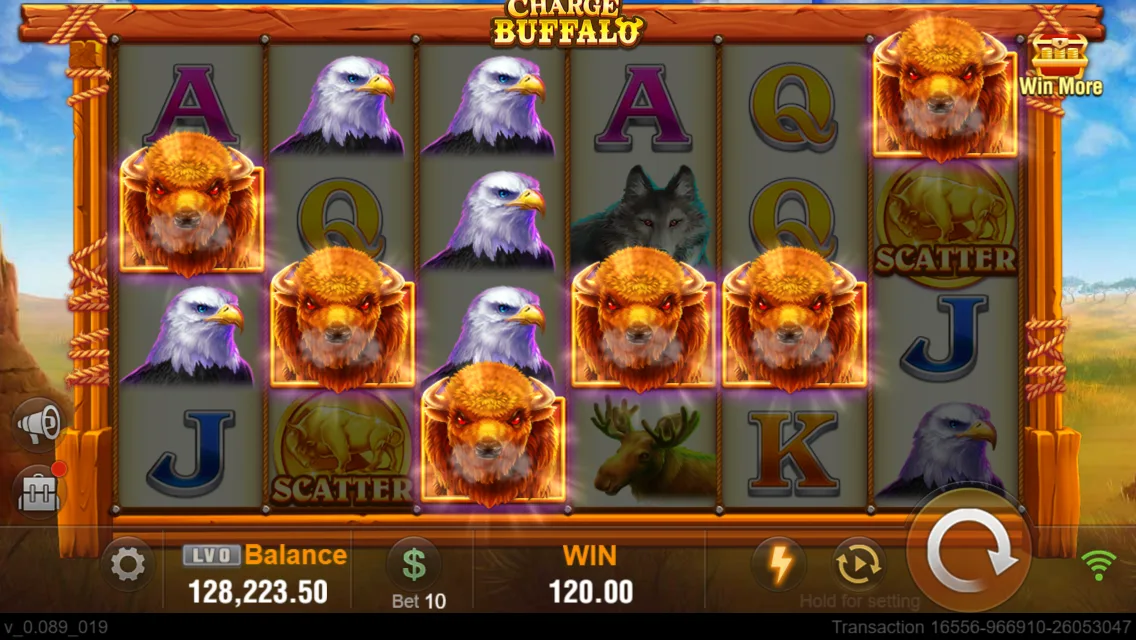
Choosing where to play in the Philippines
PAGCOR's published JILI list, dated 19 May 2026, includes the original Charge Buffalo, Charge Buffalo ASCENT, and 3 Charge Buffalo. That tells you the titles exist in a regulatory document. It does not prove that any particular website holds a licence, currently stocks the game, or will process your withdrawals. Keep those questions separate when you evaluate anywhere to play.
Before depositing, verify the operator on its own merits. Look for a clearly stated licence, reachable customer support, and published payment terms. We did not find verified evidence of which Philippine operators currently carry this game, and we found no corroborated first-hand Philippine player reports about GCash or Maya acceptance for it, so any site claiming effortless local payments deserves scrutiny rather than trust.
Check the game configuration too. The original's official sheet lists RTP settings of 96.08, 96.53, 97.03, or 97.51 percent selected by the operator, and the sheet gives Euro stakes from 0.1 to 100 rather than confirmed Philippine peso limits. Ask support which version of the game and which stake range you would actually get in pesos before assuming anything.
Finally, plan your budget in pesos with a worked hypothetical for clarity: if you set aside 1,000 pesos and decide 20 pesos per spin, that funds 50 spins if every spin returns zero and the stake stays fixed; reinvesting returns would increase turnover. The sheet lists a 25.60 percent hit frequency, but since its definition is not supplied, it cannot reliably predict how many of those 50 spins would return anything, and many wins may be smaller than the stake. RTP is theoretical long-run behaviour, never a forecast for your session.
Which guide should you read next?
If you are brand new and landed here first, start with the guide on which Charge Buffalo you are opening, because three separate games share the name. The original is a six-reel, four-row title with a 4000x maximum, ASCENT is a five-reel forty-line game with a 20000x maximum, and 3 Charge Buffalo is a five-reel 1024-ways game with a 10000x maximum. Confusing them leads to wrong expectations about volatility and payouts.
Once you have the right version identified, read the guide on following one complete paid round. It walks through what you see from setting a stake to the final return, and pairs naturally with the guide on reading the stake and the final return. Together they cover the full cost versus return versus net picture, using clearly labelled hypothetical peso arithmetic rather than promises about outcomes.
If mechanics are your main interest, the ways-to-win guide explains how 4096 arrangements are counted and why that number is not a probability, while the symbols guide separates what the Buffalo, Wild, and Scatter each do. The free-spins guide covers what actually changes during the bonus, including the wild multiplier feature the provider describes, and the versions guide compares all three games side by side.
Practical readers on the go should check the phone guide, which explains how to play on a mobile without losing sight of the controls, and the controls guide before touching any shortcut buttons like auto-play or lightning mode. Read whichever guide matches your immediate question; each one stands alone, and you can return to this page whenever you are ready for the next step.
Check the sources
JILI · Charge Buffalo · TaDa · Charge Buffalo game sheet · PAGCOR · JILI game list, 19 May 2026
Sources →